Urgent problem
Name the decision maker, user, workflow, consequence, budget path, alternative, and reason to act now.
A useful PropTech thesis links a specific buyer problem to adoption, delivery, economics, defensibility, and risk. It also states which evidence would weaken or invalidate that chain.
Because this buyer experiences this costly problem under these constraints, this product can change this workflow through this mechanism; the company can deliver, capture, and defend enough value; and these milestones, economics, risks, and falsifiers will show whether the thesis is holding.
Thesis in view
A good thesis links a specific assumption to delivery evidence and a clear condition that would change the decision.
 01
01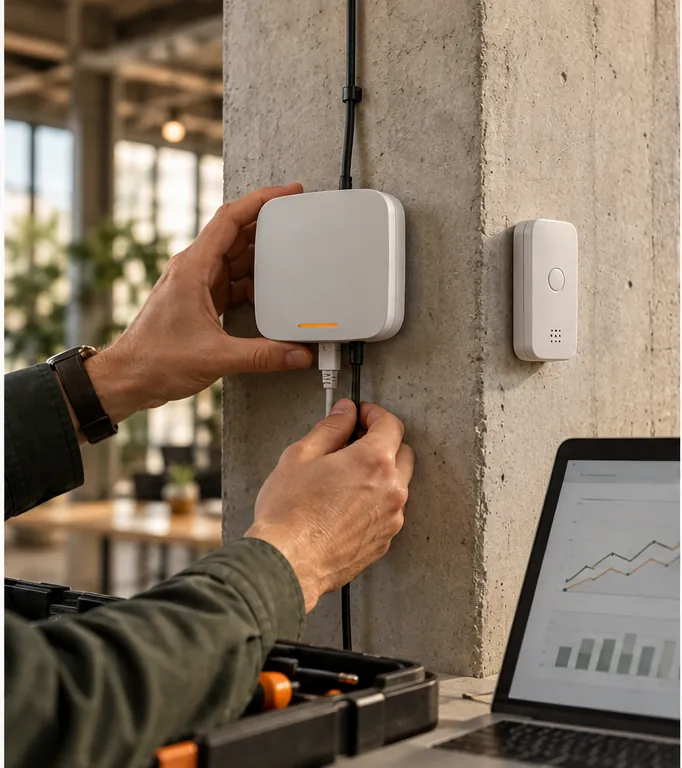 02
02 03
03Published 8 September 2026 · reviewed 9 September 2026. Editorial illustrations generated for Hamed Helped; they do not depict a named site, vendor, or client.
Decision criteria
Name the decision maker, user, workflow, consequence, budget path, alternative, and reason to act now.
Explain which action changes and how that change reaches revenue, cost, risk, resilience, or service.
Underwrite integration, implementation, property access, procurement, training, support, and time to useful operation.
Test pricing basis, gross margin, services burden, sales cycle, retention mechanism, expansion, and cash needs.
Separate durable workflow, data, distribution, integration, trust, and switching advantages from feature lead.
State regulatory, security, data, property-cycle, customer-concentration, platform, and financing assumptions.
Questions to ask
Map the buying committee, daily user, system owner, security reviewer, procurement path, and budget owner.
Follow one workflow from current friction through changed behavior to an observable property or business outcome.
Separate configuration, integration, hardware, site work, migration, training, support, and bespoke services.
Test budget source, mission criticality, customer payback logic, financing needs, and retention under stress.
Look for reusable product, distribution, data rights, integrations, operating knowledge, and lower implementation friction.
Write adoption, retention, margin, delivery, security, concentration, and financing thresholds before the next update.
Evidence table
| Claim or decision | Evidence | Owner | When checked |
|---|---|---|---|
| Buyer urgency | Observed workflow, consequence, budget, reference calls, alternative behavior | Investment lead | Initial diligence and customer review |
| Deployment repeatability | Implementation cohorts, time-to-operation, integration mix, services hours, exception log | Product/technical diligence | Before underwriting scale |
| Economic quality | Revenue bridge, cohort retention, margin by delivery type, acquisition and support cost | Financial diligence | Base case and each milestone |
| Defensibility | Win/loss evidence, switching path, data and contract rights, distribution, replication test | Investment team | Before entry and follow-on |
| Risk acceptance | Regulatory map, security posture, incident history, concentration, financing and downside cases | Named specialist + investment lead | Before decision and material change |
Failure modes
A large real-estate market is treated as evidence that a specific customer will buy and adopt a specific workflow change.
Signed tests are counted without time-to-value, active use, expansion, retention, or delivery economics.
A technology label stands in for data rights, accuracy, workflow integration, review, liability, and economic value.
Aggregate capital or a large round is read as category validation without stage, instrument, concentration, or company evidence.
Find the break
Evidence trail
Current analysis used to separate aggregate funding from stage, category, deal-size, and capital-type signals.
Current diligence framework across company, commercial, product, technology, legal, regulatory, financial, and governance readiness.
Survey evidence for category and sentiment context—not a forecast.