Problem fit
Name the operator, current process, failure or friction, changed action, and downstream handoff.
A polished demonstration proves that a path can be shown. Due diligence asks whether the path survives your data, systems, people, building constraints, commercial terms, and exit.
Write the operating problem, current baseline, promised mechanism, integration path, security and data obligations, acceptance test, owner, and exit condition in one page. If the vendor and buying team cannot agree on that chain, more features will not repair the decision.
Diligence in view
A product claim is only as strong as the hardware, integration boundary, and handover that support it.
 01
01 02
02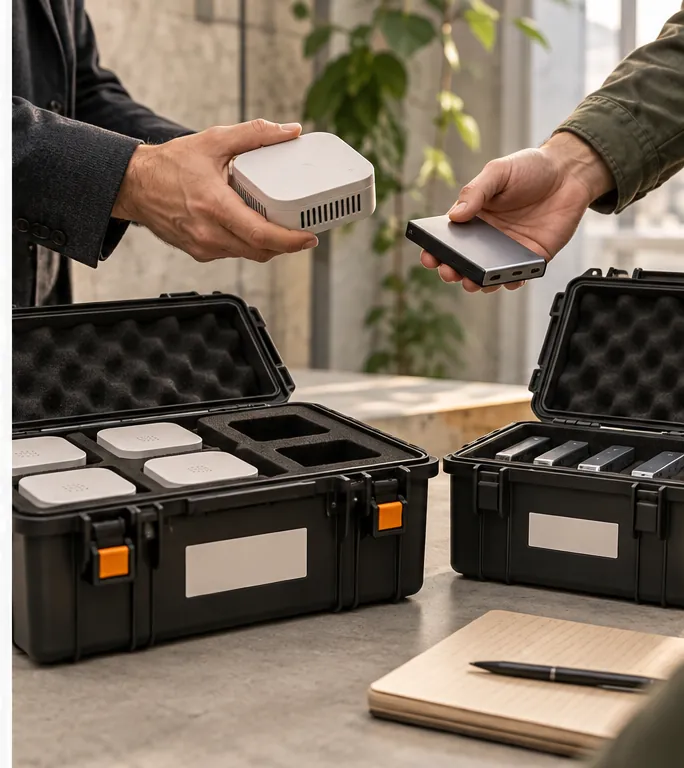 03
03Published 8 September 2026 · reviewed 9 September 2026. Editorial illustrations generated for Hamed Helped; they do not depict a named site, vendor, or client.
Decision criteria
Name the operator, current process, failure or friction, changed action, and downstream handoff.
Require a comparable baseline, observable outcome, measurement method, timeframe, and acceptance owner.
Set source, access, validation, retention, sharing, model-use, export, deletion, and exit rights.
Map dependencies, identifiers, interfaces, change windows, incident paths, and responsibility boundaries.
Review assets, identities, remote access, updates, logs, backups, recovery, and end-of-support decisions.
Test pricing basis, implementation burden, ongoing services, dependencies, contract change, transition, and replacement.
Questions to ask
Which exact steps disappear, change, or move to a different person—and what new task is created?
When a percentage improvement is claimed, what population, baseline, time period, exclusions, and comparison produced it?
Which systems provide and receive data, who maintains each interface, and what happens when one is unavailable?
Which raw, normalized, configured, and derived data can the owner export, in what format, at what cost, and on what timeline?
How are security events, outages, unsafe states, errors, and disputed results detected, escalated, recovered, and evidenced?
How are credentials revoked, integrations separated, configurations transferred, hardware handled, and operations sustained?
Evidence table
| Claim or decision | Evidence | Owner | When checked |
|---|---|---|---|
| Workflow value | Current-state map, named user, baseline, pilot protocol, and acceptance threshold | Operations | Before pilot approval |
| Integration feasibility | Architecture, interfaces, data dictionary, responsibilities, test and rollback plan | System owner + IT | Before technical commitment |
| Security acceptance | Asset scope, identity and remote-access model, update and incident processes, recovery evidence | Security + operations | Before connection |
| Data control | Contract terms, permissions, quality rules, lineage, export sample, retention and deletion path | Data owner + legal | Before signature |
| Commercial durability | Total cost model, service dependencies, change terms, support scope, exit and transition obligations | Procurement + finance | Before award and at renewal |
Failure modes
A staged experience replaces evidence from the actual workflow and asset conditions.
A preferred product is chosen before its identities, access paths, lifecycle, and recovery are visible.
Temporary access, data handling, support, and exceptions quietly become the permanent architecture.
Data, configuration, integrations, credentials, and operating knowledge cannot be transferred cleanly.
Apply the gates
Evidence trail
Current framework spanning legal, financial, regulatory, commercial, product, technology, and governance readiness.
Owner/operator guidance on direct access to and export of system data.
Primary risk-based OT security and lifecycle guidance.
Industry guidance supporting security governance during building-technology procurement.